

The dental associate agreement is an important part of taking any job as a dental associate. But sometimes this agreement can be tricky to navigate. One place where dentists get tripped up is regarding associate pay. A dental associate agreement may promise compensation of “30% of adjusted production” or “35% of collections.” Those numbers look easy to compare. They often aren’t.
The percentage is only half of the compensation formula. What the percentage is applied to can have just as much impact on a dental associate’s actual pay.
Production, adjusted production, and collections measure different things. Even two contracts that offer the same percentage can result in very different compensation depending on how the agreement defines the compensation base, which amounts are deducted, how collections are handled, and when compensation is calculated.
Before signing a dental associate agreement, dentists should understand not only what percentage they will receive, but also a percentage of what.
How Are Dental Associates Typically Paid?
Dental associates may be compensated through a fixed salary or daily rate, a percentage-based compensation model, or a combination of guaranteed compensation and incentive compensation.
Percentage-based compensation commonly uses one of three measurements:
- production;
- adjusted production; or
- collections.
The associate agreement should clearly identify which method applies and, importantly, define exactly how the applicable amount is calculated.
A contract that simply states that an associate will receive “30% of production” without adequately defining production may leave important compensation questions unanswered.
What Is Production in a Dental Associate Agreement?
Production generally refers to the value of dental services performed by the associate based on the practice’s fee schedule.
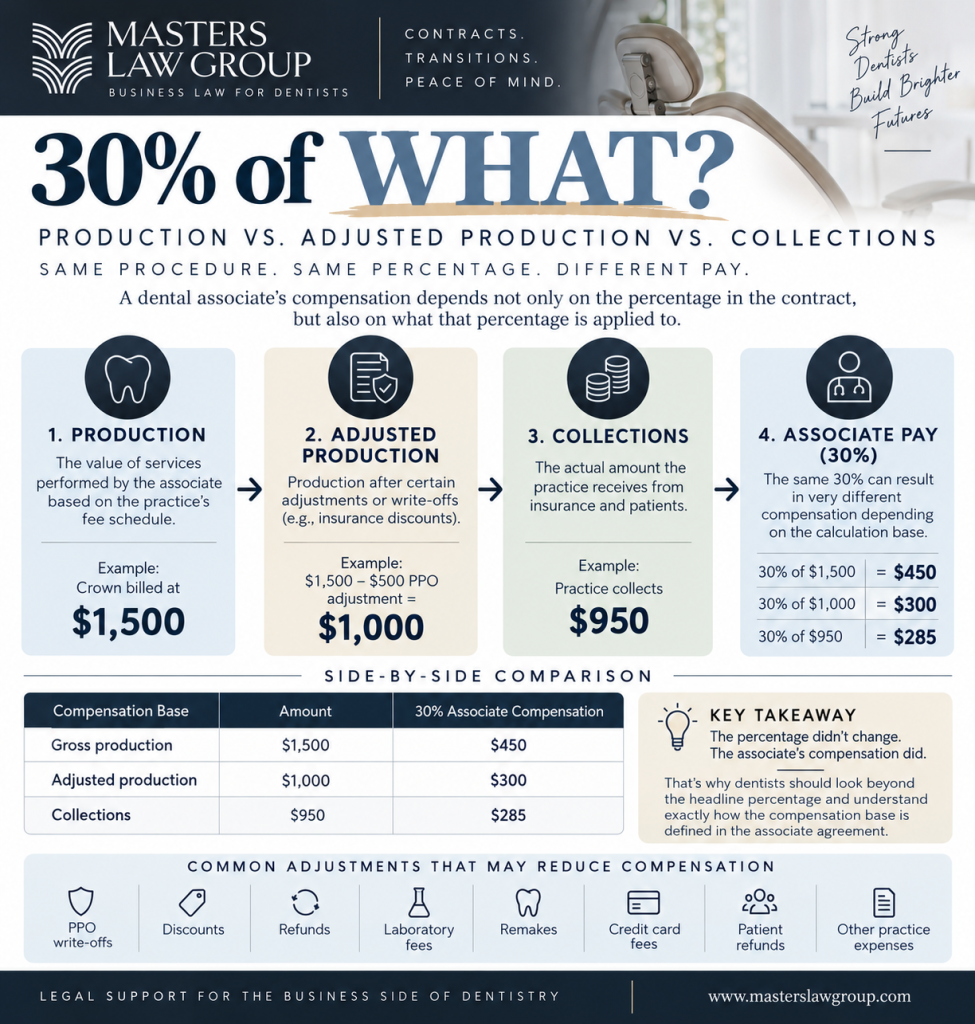
For example, assume a practice’s standard fee for a crown is $1,500. If the associate performs the crown, the practice may record $1,500 in gross production.
If the associate’s compensation is 30% of gross production, that procedure would initially generate:
$1,500 × 30% = $450
But the practice may never actually receive $1,500.
If the patient is covered by a PPO that permits the practice to collect only $1,000 for that procedure, the remaining $500 may be written off.
That distinction is why the words following the compensation percentage matter so much.
What Is Adjusted Production for a Dental Associate?
Adjusted production generally means the associate’s gross production after certain adjustments or write-offs are deducted.
Those adjustments may include contractual insurance write-offs, discounts, refunds, remakes, or other amounts specified in the associate agreement.
Suppose the practice charges $1,500 for a crown but its agreement with the patient’s PPO allows the practice to collect only $1,000.
The numbers might look like this:
- Gross production: $1,500
- PPO contractual adjustment: $500
- Adjusted production: $1,000
If the associate receives 30% of adjusted production, compensation attributable to that procedure would be:
$1,000 × 30% = $300
However, there is no reason to assume that every dental associate agreement uses the term “adjusted production” in exactly the same way.
The contract’s definition controls.
An associate reviewing an adjusted-production formula should determine precisely which adjustments the practice can subtract before calculating compensation.
What Does Collections Mean for a Dental Associate?
Collections-based compensation pays the associate based on money the practice actually receives for the associate’s services rather than merely the amount billed or produced.
Using the same example, suppose:
- Gross production is $1,500;
- Adjusted production is $1,000; and
- The practice ultimately collects $950.
At 30% of collections, the associate would receive:
$950 × 30% = $285
Collections therefore shift some collection risk to the associate.
That isn’t necessarily an unreasonable compensation structure. But an associate should understand that the dentist typically has limited control over the practice’s billing systems, collection policies, staffing, insurance follow-up, or decisions to write off patient balances.
Production vs. Adjusted Production vs. Collections: What’s the Difference?
Consider the same dental procedure under each compensation model:
| Compensation Base | Amount | 30% Associate Compensation |
|---|---|---|
| Gross production | $1,500 | $450 |
| Adjusted production | $1,000 | $300 |
| Collections | $950 | $285 |
The percentage did not change.
The associate’s compensation did.
This is why comparing dental associate offers solely by percentage can be misleading.
A dentist offered 32% of adjusted production could potentially earn more than a dentist offered 35% of collections, depending on the practice’s fee schedules, insurance participation, collection rate, adjustments, and contract language.
Is Adjusted Production Better Than Collections for a Dental Associate?
From an associate’s perspective, adjusted production can offer an important advantage over collections because compensation is generally less dependent on the practice’s ability to collect payment after the dentist performs the work.
However, whether adjusted production is actually more favorable depends on how the agreement defines it.
For example, an agreement should make clear whether adjusted production can be reduced for:
- PPO and other contractual insurance adjustments;
- discretionary discounts;
- refunds;
- bad debt;
- laboratory fees;
- remakes;
- credit card fees;
- patient refunds;
- hygiene services;
- procedures later completed or corrected by another provider; or
- other practice expenses.
A broadly drafted definition can substantially change the economics of an otherwise attractive compensation percentage.
Is It Better for a Dentist to Be Paid on Production or Collections?
There is no universally best compensation structure for every dental associate. The better arrangement depends on the percentage offered, how the compensation base is defined, the practice’s payer mix and collection performance, and which financial risks the contract places on the associate.
Gross production may provide a larger compensation base, but a practice may offer a lower percentage.
Adjusted production may more closely reflect the amount the practice is actually entitled to receive after contractual insurance adjustments.
Collections may be paired with a higher percentage, but the associate’s compensation then depends partly on the practice’s collection performance.
The best way to compare offers is therefore not simply:
“Which practice is offering the highest percentage?”
Instead, ask:
“What would I actually have been paid under this formula using this practice’s real historical numbers?”
What Questions Should a Dentist Ask Before Accepting a Percentage-Based Compensation Formula?
Before signing an associate agreement, a dentist should consider asking the practice for enough information to understand how the compensation formula works in practice.
Useful questions may include:
1. What is the practice’s historical collection rate?
If compensation is based on collections, the practice’s ability to collect amounts owed directly affects the associate’s compensation.
2. What percentage of the practice is PPO versus fee-for-service?
A practice’s payer mix can materially affect the difference between gross and adjusted production.
3. How exactly is “adjusted production” defined?
Do not assume the term has a universal meaning. Review the actual contractual definition.
4. Which expenses or adjustments can be deducted?
The agreement should identify the deductions that can reduce the associate’s compensation base.
5. How are patient refunds handled?
Can a refund months later be deducted from future compensation? What happens if the associate is no longer employed?
6. How are remakes handled?
If work must be redone, determine whether the original associate loses production credit and under what circumstances.
7. Who receives production credit when multiple dentists participate in treatment?
Complex treatment plans may involve exams, treatment planning, restorative work, surgery, hygiene, or other services performed by multiple providers.
8. When is compensation calculated and paid?
Monthly calculations, quarterly reconciliations, and delayed collection-based payments can produce very different cash-flow experiences for an associate.
9. Can the associate verify the calculation?
The agreement should address whether the associate will receive reports or other information sufficient to verify compensation.
Watch for Lab Fee Deductions
Laboratory fees deserve special attention in dental associate agreements.
Some practices calculate an associate’s percentage and then deduct some or all laboratory expenses. Others subtract laboratory expenses before applying the compensation percentage.
Those approaches are mathematically different.
For example, suppose adjusted production is $1,000, the associate earns 30%, and the lab bill is $200.
One formula could be:
($1,000 − $200) × 30% = $240
Another could be:
($1,000 × 30%) − $200 = $100
That is a significant difference.
A dental associate agreement should make the calculation clear rather than leaving the parties to determine later what “30% less lab fees” was supposed to mean.
What Happens to Collections After a Dental Associate Leaves?
This issue can be especially important when compensation is based on collections.
Imagine an associate performs substantial dental work in June and leaves the practice on June 30. The practice receives some of the related insurance and patient payments in July and August.
Does the former associate still receive their percentage of those collections?
The agreement should answer that question.
Associates should review provisions addressing post-termination compensation, final reconciliation, outstanding collections, refunds, chargebacks, and the timing of the final payment.
Without clear language, the end of the employment relationship can create disputes over compensation for work already performed.
Should a Dental Associate Have Access to Production and Collection Reports?
If compensation depends on production, adjusted production, or collections, the associate should consider whether the agreement provides a practical way to verify the numbers used to calculate compensation.
For example, the agreement may provide for periodic compensation statements or reasonable access to reports showing the associate’s production, adjustments, collections, and applicable deductions.
A compensation formula is much more useful when both parties can determine how the final number was calculated.
Can a Dental Associate Negotiate the Compensation Formula?
Yes. Compensation provisions in a dental associate agreement can be negotiated.
Depending on the circumstances, an associate might negotiate:
- the compensation percentage;
- production versus adjusted production versus collections;
- the definition of adjusted production;
- which deductions are permitted;
- treatment of lab expenses;
- a guaranteed daily rate or salary during an initial period;
- a minimum compensation amount;
- timing of compensation payments;
- post-termination collections;
- compensation reporting; or
- reconciliation procedures.
The percentage is therefore only one part of the negotiation.
Sometimes changing the definition underneath the percentage is more valuable than negotiating another percentage point.
Example: Why a Higher Percentage Doesn’t Always Mean Higher Pay
Consider two offers.
Practice A:
35% of collections
Practice B:
32% of adjusted production
At first glance, Practice A appears to offer better compensation.
But suppose an associate generates $50,000 in adjusted production during a month.
If Practice A ultimately collects 88% of that amount:
$50,000 × 88% = $44,000 in collections
$44,000 × 35% = $15,400
Practice B:
$50,000 × 32% = $16,000
Despite offering the lower percentage, Practice B would pay $600 more for that month under these assumptions.
The example illustrates why dentists should compare the entire compensation formula rather than the headline percentage.
Dental Associate Compensation Red Flags
Compensation language deserves closer review when an agreement:
- uses “production” or “adjusted production” without defining the term;
- permits deductions without clearly identifying them;
- allows the practice broad discretion to modify the compensation calculation;
- bases compensation on collections without explaining post-termination collections;
- deducts lab expenses without explaining the calculation;
- provides no meaningful way for the associate to verify compensation;
- allows discretionary write-offs to reduce associate compensation;
- does not explain refunds or chargebacks;
- permits unilateral changes to compensation; or
- contains a compensation example that does not match the operative contract language.
Ambiguity is particularly problematic in compensation provisions because small differences repeated across hundreds of procedures can become substantial over the course of a year.
Should a Lawyer Review a Dental Associate Compensation Agreement?
A dental associate agreement affects much more than the associate’s headline compensation percentage.
An attorney familiar with dental associate agreements can review how compensation is defined, identify deductions and other provisions affecting actual pay, and evaluate the compensation provisions together with termination rights, restrictive covenants, professional liability provisions, benefits, schedules, and other contractual terms.
Ideally, the agreement should be reviewed before it is signed, when the dentist still has the ability to ask questions and negotiate changes.
Dental Associate Agreement Review
Masters Law Group helps dentists review and negotiate dental associate agreements, including compensation provisions involving production, adjusted production, collections, lab expenses, guarantees, bonuses, and post-termination compensation.
If you have received a dental associate agreement and want to understand what the compensation formula actually means before signing, contact Masters Law Group to discuss an associate agreement review.
Book a complimentary call with us here to learn more.
This post was drafted by Amber Masters, Esq. and Managing Attorney at Masters Law Group. This article is provided for general informational purposes and is not legal advice. Contract terms and applicable law vary, and dentists should obtain advice regarding their particular circumstances.